Online personal training is no longer a side hustle — it’s a real career. In 2026, more coaches than ever are building fully online or hybrid coaching businesses, working with clients across cities, countries, and time zones.
But the path isn’t obvious. Most new coaches get stuck in the same loop: a few clients on Instagram DMs, a Google Sheet for workouts, and no real system. They’re busy, but not actually building a business.
This guide breaks down how to start an online personal training business in 2026 — from positioning to pricing to delivery — with a focus on what actually moves the needle.
Step 1: Pick a clear niche (don’t skip this)
“I help anyone get fit” is not a business — it’s a hobby. The strongest online coaches in 2026 are specialists.
A clear niche gives you:
- A specific person to talk to in your content
- Higher prices (specialists charge more than generalists)
- Faster word-of-mouth growth
- Easier coaching (you reuse what works)
Examples of strong niches:
- Strength training for women in their 30s and 40s
- Hybrid training for runners
- Online coaching for desk-job clients with back pain
- Body recomposition for busy professionals
- Athletic performance for amateur footballers
Pick something you genuinely understand and would enjoy doing for the next 3–5 years.
Step 2: Define your offer and pricing
Most new online coaches undercharge. They quote “$80/month for unlimited coaching” and burn out in 6 months.
Build your offer around outcomes, not features.
A clean structure:
- What the client gets (program, check-ins, communication, progress tracking)
- How often you interact (weekly, bi-weekly, on-demand)
- What success looks like (clear, specific, time-bound)
- What it costs (one fair, confident number)
A reasonable starting range for serious online coaching in 2026 is $150–$400/month per client, depending on niche, deliverables, and your experience. Premium niches (post-rehab, elite performance, executives) can go much higher.
Rule of thumb: if you wouldn’t pay your own price for the experience you deliver, raise the experience or lower your stress by raising the price.
Step 3: Build a simple, scalable delivery system
This is where most coaches fail. They get clients before they get a system, and then drown.
You need a delivery system that handles:
- Onboarding (intake form, goals, history)
- Programming (workout templates you can reuse)
- Execution (clients see exactly what to do today)
- Tracking (sets, reps, weight, time, photos)
- Check-ins (weekly review, adjustments)
- Communication (feedback that doesn’t get lost in chat)
Without this, every new client adds chaos. With this, every new client adds revenue.
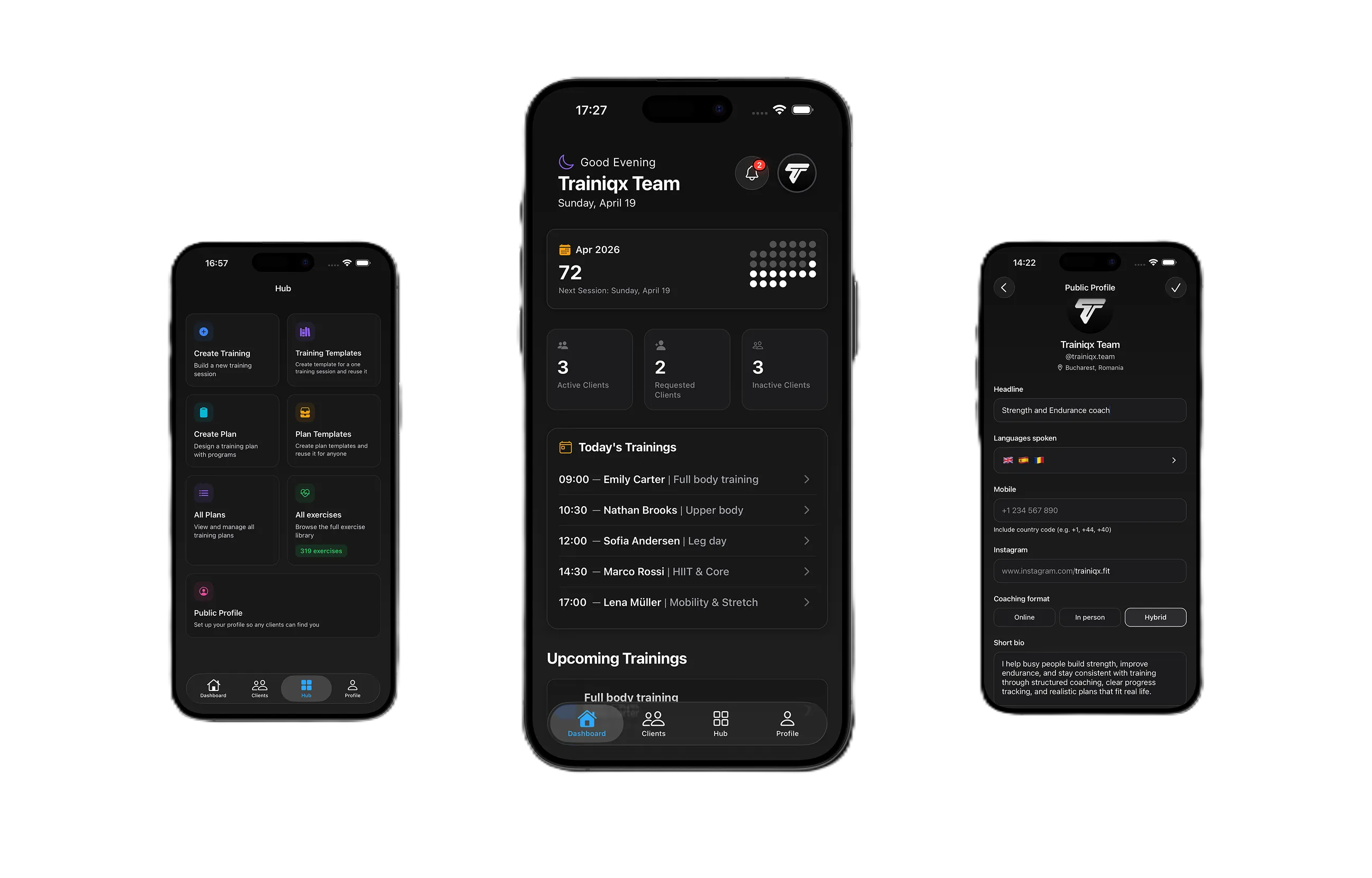
Trainiqx is built around this exact workflow — templates, session delivery, performance tracking, and history in one place — so coaches can scale without rebuilding their process every time.
Step 4: Create content that attracts the right clients
You don’t need a million followers. You need the right 1,000 people who trust you.
Effective content for online personal trainers in 2026:
- Short-form video (Instagram Reels, TikTok, YouTube Shorts) showing real coaching points
- Long-form (YouTube, blog posts like this one) for trust and SEO
- Case studies of real client transformations (with permission)
- Email newsletter so you’re not renting your audience from algorithms
Pick 2 platforms max at the start. Consistency beats variety.
A simple weekly content rhythm:
- 3 short videos
- 1 long-form piece (YouTube or blog)
- 1 email/newsletter
- 1 personal story / behind-the-scenes post
Step 5: Get your first 10 clients (without ads)
Most coaches don’t have a marketing problem. They have a conversation problem.
Where your first clients usually come from:
- People already in your network (friends of friends)
- Past in-person clients moving online
- Audience members who already engage with your content
- Free strategy calls / assessments
- Referrals from your first happy clients
Tactical approach for the first 10:
- List 50 people you could reach out to personally.
- Offer a no-pressure intro call or free assessment.
- Deliver an outstanding experience to the first 3–5 (even at lower pricing).
- Ask each happy client for one referral and one testimonial.
- Use those testimonials and case studies in your content.
Once you’ve coached 10 clients well, raising prices and getting more clients becomes far easier.
Step 6: Set up the business essentials
Don’t over-engineer this, but don’t skip it either.
- Legal & tax: register the right entity for your country, set up invoicing
- Payments: Stripe, Wise, or local equivalents
- Contracts: a clear coaching agreement (scope, payment, cancellation)
- Privacy: be careful with photos, data, and health information
- Insurance: consider liability insurance depending on your country
You don’t need fancy software here — you need clarity.
Step 7: Build retention, not just sales
The best online coaching businesses in 2026 aren’t the loudest — they’re the stickiest.
A client who stays 12 months is worth far more than three clients who leave after 2.
Retention drivers:
- Visible progress (this is why tracking matters so much)
- A predictable rhythm (sessions, check-ins, reviews)
- Real connection (you actually know them)
- Continuous evolution (their plan keeps adapting, not stagnating)
If you nail retention, you don’t need to constantly chase new leads.
Step 8: Scale without burning out
The coach who works 14 hours a day is not winning. They’re just running faster.
To scale calmly:
- Standardize what can be standardized (templates, onboarding, check-ins)
- Personalize what truly needs personalization (programming decisions, feedback)
- Cap your roster (decide your max number of 1:1 clients)
- Add a tier above 1:1 (group coaching, courses, premium VIP) once you’re full
- Use software that does the admin so you can do the coaching
The coaches who last 5+ years don’t have more energy. They have better systems.
Tools to start your online personal training business
You don’t need 12 tools. You need a small, sharp stack:
- Coaching app: Trainiqx for templates, sessions, tracking, and history
- Video calls: Zoom, Google Meet, or FaceTime
- Payments: Stripe (or your local equivalent)
- Content: your phone + a basic editing app
- Email: any simple newsletter tool when you’re ready
- Notes/CRM: start with a simple doc; upgrade only when needed
Start lean. Add tools only when something is genuinely broken.
Final word
Starting an online personal training business in 2026 is more accessible than ever — and more crowded than ever. The coaches who win are the ones who:
- Pick a clear niche
- Charge fair, confident prices
- Build a real delivery system from day one
- Show measurable progress to their clients
- Stay consistent for 12+ months
If you put a system around your coaching from the start, you’ll skip the chaos most new online coaches experience.
When you’re ready to remove the spreadsheets, screenshots, and chaos from your coaching delivery, give Trainiqx a try:
- Website: https://trainiqx.com
- App Store: https://apps.apple.com/us/app/trainiqx/id6747919113
Build the business once. Scale it for years.